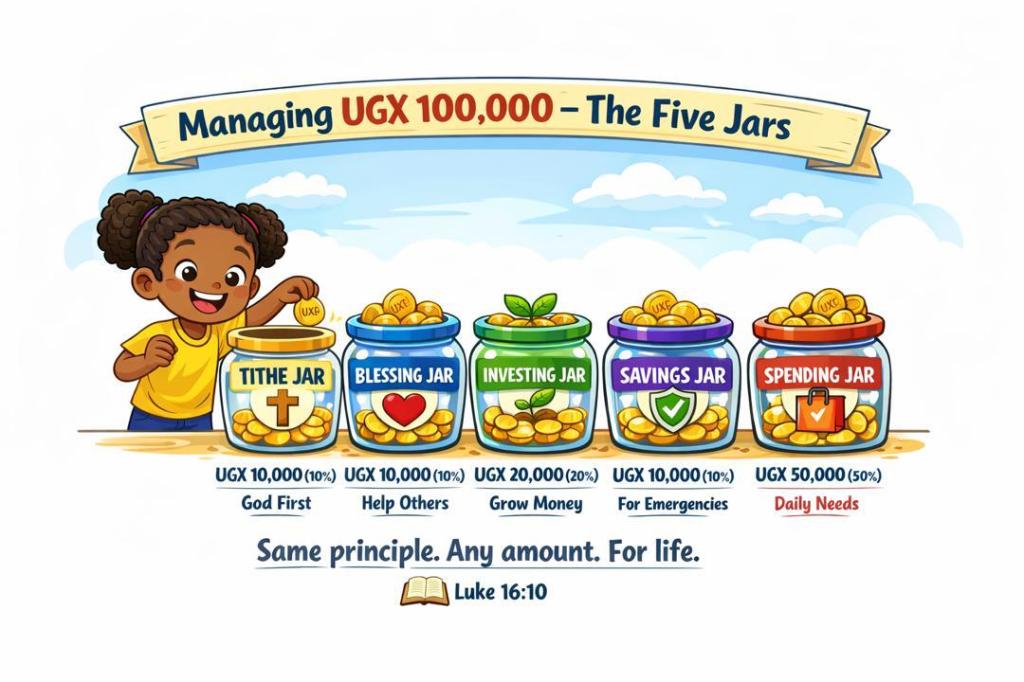
Money is one of the earliest tools of independence most people encounter, yet it is rarely accompanied by wisdom on how to manage it well. For many young adults, income arrives before instruction, and financial decisions are made through trial, pressure, or imitation rather than intention. The result is often confusion, anxiety, debt, and a fractured relationship with money. The 5 Jars Principle offers a simple yet profound framework that restores clarity, discipline, and purpose to personal finance, while anchoring financial decisions in faith and values.
At its heart, the 5 Jars Principle is not merely a budgeting method; it is a stewardship mindset. It teaches that money is not owned absolutely, but entrusted. This perspective shifts the focus from consumption to responsibility, from impulse to planning, and from scarcity to purpose. By assigning every portion of income a role before spending begins, individuals learn to lead their money rather than react to it.
The principle is often taught using physical jars, especially for children and young adults, because it transforms an abstract concept into a visible, practical habit. Each jar represents a clear financial priority. As income is received, it is intentionally divided, reinforcing the idea that wise financial living is proactive, not accidental. Over time, this practice shapes character as much as it shapes bank balances.
When applied consistently, the 5 Jars Principle nurtures financial maturity by integrating faith, generosity, growth, preparation, and enjoyment into one coherent system. It recognises that financial health is not achieved by focusing on one area alone, but by maintaining balance across all aspects of life.
The five jars are introduced as follows.
The first jar is the Tithe Jar, which represents putting God first. This jar is set aside before anything else, affirming that God is the source of all provision. By honouring God with the first portion of income, individuals cultivate gratitude, humility, and trust. Scripture reminds us, “Honor the LORD with your wealth, with the firstfruits of all your crops” (Proverbs 3:9), and further affirms that “a tithe of everything… belongs to the LORD” (Leviticus 27:30). Tithing is therefore not framed as loss, but as alignment — a declaration that faith governs financial decisions. This practice trains the heart to depend on God rather than money and establishes spiritual order in personal finances.
The second jar is the Blessing Jar, dedicated to generosity towards others. This jar reflects the understanding that money is also a tool for compassion and community. Through intentional giving, individuals learn to look beyond themselves and recognise the needs around them. The Bible teaches, “Give, and it will be given to you” (Luke 6:38), and also assures us that “a generous person will prosper; whoever refreshes others will be refreshed” (Proverbs 11:25). Generosity builds empathy, strengthens relationships, and reminds us that wealth finds its highest purpose when it uplifts others. This jar guards against selfishness and nurtures a lifestyle of kindness and service.
The third jar is the Investing Jar, which focuses on long-term growth. Here, individuals are encouraged to think beyond immediate needs and pleasures, and to plan for the future with wisdom and diligence. Scripture affirms this principle clearly: “The plans of the diligent lead surely to abundance” (Proverbs 21:5), and “whoever gathers money little by little makes it grow” (Proverbs 13:11). Investing teaches patience, discipline, and responsibility. Whether through education, entrepreneurship, or structured investments, this jar equips individuals to grow resources steadily and sustainably over time.
The fourth jar is the Savings Jar, which prepares individuals for life’s uncertainties and opportunities. Saving is an expression of wisdom and foresight. The Bible uses the example of the ant to illustrate this truth: “Go to the ant, you sluggard; consider its ways and be wise” (Proverbs 6:6). It further states that “the wise store up choice food and olive oil” (Proverbs 21:20). By setting aside funds for emergencies or future needs, individuals avoid panic-driven decisions and unnecessary debt. This jar fosters peace of mind and reinforces the value of preparation.
The fifth and final jar is the Spending Jar. After honouring God, giving generously, investing wisely, and saving intentionally, individuals are free to enjoy what remains responsibly. Scripture affirms that enjoyment, when rightly ordered, is part of God’s design: “There is nothing better for people than to enjoy their work… this is a gift from God” (Ecclesiastes 3:13). This jar acknowledges that balance matters — life is meant to be lived fully, not anxiously. By placing spending last, the system ensures that enjoyment does not undermine stewardship, but flows from it.
What makes the 5 Jars Principle particularly effective is its simplicity. It is easy to understand, easy to teach, and easy to adapt to different income levels. More importantly, it works because it aligns behaviour with values. It removes ambiguity from financial decisions and replaces it with clarity. Every coin has a purpose, and every choice becomes intentional.
For young adults especially, this framework lays a strong foundation. It encourages living within one’s means, avoiding unnecessary debt, building financial resilience, and developing a healthy relationship with money early in life. Over time, the jars may change in size as income grows, but the principles remain constant.
Ultimately, the 5 Jars Principle reminds us that financial wisdom is not separate from spiritual life. How we manage money reflects what we value, what we trust, and what we prioritise. When finances are stewarded with intention and faith, they become a source of peace rather than pressure, and a means of purpose rather than anxiety.
Wise stewardship is not about how much we earn, but how faithfully we manage what we receive.
For further reading and additional perspectives on the 5 Jars Principle:
 Becoming Golden
Leave a comment